
Dying to Know
From Beethoven’s morendo to Satie’s surreal asides, what do words in a score really ask of performers? A conversation with the Ariel Quartet.

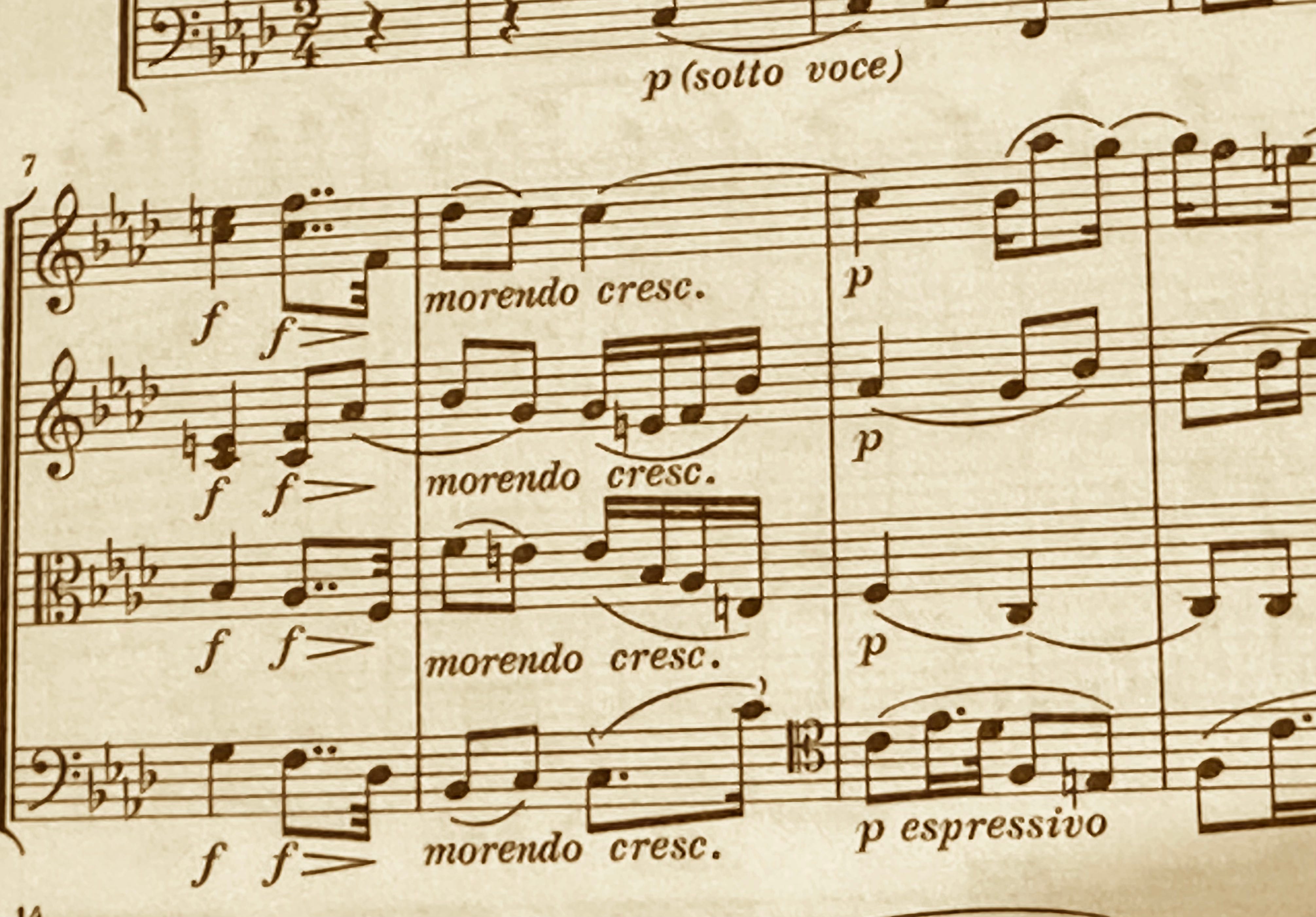
At a recent rehearsal with my string quartet, we had barely begun the slow movement of Beethoven’s Op. 59, No. 1 when we stopped playing and started debating. One bar near the end of the mournful theme was marked decrescendo. So far, so clear: Play more quietly. Two bars later came a crescendo — the opposite. But nestled between them was a single word, written in Italian under the staff: morendo, or “dying.”
Beethoven already had us fading the volume. He could have simply extended the hairpin, that greater-than sign composers use to indicate a decrescendo. So why reach for a word? He seemed to be after something more than a drop in volume, a sense of life draining out of the phrase. But did he mean for the pulse to slow, too? Or just for the sound to grow thinner, paler, more frail?
That rehearsal moment sent me down a rabbit hole of musical words that resulted in an essay published in today’s New York Times. I’ve long been fascinated by composers who use language to stretch notation beyond the technical into the poetic or absurd. Erik Satie, especially, turned performance indications into surreal little provocations. In his scores you might find: “As if you were congested;” “Avoid any sacrilegious excitement;” “Courageously easy and obligingly alone;” “Like a beast;” “Moderate and very bored;” and the perennial favorite: “Like a nightingale with a toothache.”
So when I set out to understand how players navigate these markings I turned to musicians who live with them every day. The Ariel Quartet is in the midst of playing all of Beethoven’s quartets, a project that immerses them in his world of Italian and German insertions. I spoke with Jan Grüning, the quartet’s German-born violist, and Gershon Gerchikov, one of its violinists, who is Israeli. Who better to ask for advice on how, as string players, one might convincingly expire on cue?
In the article, I was only able to use a sliver of a quote, but the conversation was so enjoyable that I’m posting a lightly edited version of it here:
Jan: I've been thinking about C. P. E. Bach and the first composers who used words in their own language. Because of course, Haydn and Mozart didn't use any German terms at all.
C. P. E. Bach actually started very rarely using German descriptors like sanft (soft) or zart (tender). But over the course of Beethoven's career — in his late work and some of the transitional piano sonatas — he starts using the German language.
With Beethoven, you still have both, Italian and German. I’ve wondered why he was doing that, and I think it may have been related to his own withdrawal with the loss of his hearing. The more introspective world that he developed, reflected in his later works, could have connected him to his own language as his more authentic self.
Me: Do you think the market for sheet music had anything to do with it — whether buyers would have known the Italian terms?
Jan: I think the people who would buy his music would basically know the Italian terms. It feels like a personal choice to add German. And some terms are hard to translate.
One example is in Op. 132, his late quartet, where he writes immer geschwinder alongside accelerando. As a native speaker, I connect with it as an inner unrest, an impulse. The expression comes from old German and means not only quick but also energetic, brave, forceful. Goethe and Schiller often used it in connection with haste or anxiety. So there’s a psychological aspect that doesn’t translate if you just write accelerando.
Me: I have a quartet — we’re working on Beethoven’s Op. 59 No. 1 — and in the slow movement we noticed he uses both piano and sotto voce. Isn’t that redundant?
Gershon: That’s actually a relatively old marking. It’s not just quiet, it’s also under-voiced, something fragile. So it’s not just a category of dynamic, but also a specific quality of sonority.
With Beethoven there are several processes happening: personally, musically, politically. He was a proud German, deeply touched by political developments. There’s also the sense that he became increasingly distrustful of performers and wanted to make sure they really knew what he meant. That’s one reason scholars perceive Beethoven as a Romantic — the artist as a personal entity with a very personal approach.
Me: In that same slow movement, there is a decrescendo, and then he adds morendo. What do you do with that as a quartet?
Jan: For me, it’s something I feel in my bow arm: a heaviness, maybe a slowing of the bow speed, so it has that feeling of running out of oxygen. Not necessarily literal, but a gesture. But most of the time, the words don’t tell you what to do. They tell you how to be.
Gershon: I’m a hobbyist programmer. In programming, the purpose of a piece of code is not just to be executed by a computer, it's also to be read by a human. Theater scripts are the same. One actor follows the same stage direction and the audience yawns; another does it and the room holds its breath.
So there are layers beyond concrete execution. When a composer writes something, they’re trying to encompass an internal world. Hopefully, the performer can read it, improvise it, and know what to do.
Gershon: Beethoven was often annoyed that copyists changed things without his consent. So he would mark, “I really mean this, don’t change this.” He mistrusted others’ ability to understand him, and that played a role in the markings he added.
Me: Who else comes to mind for their unusual or creative use of language?
Jan: The canonical example would be Webern’s Six Bagatelles, which in performance take about four minutes to play. And the amount of words that are written on these pages would take longer to read. Here the composer was not writing just for performance. The composer was writing an artifact that exists irrespectively of whether it will ever be performed.
Me: Philip Glass’s Piano Etudes are famously spare. In an interview with Ira Glass, he said they shouldn’t be played too rigidly — more like Schubert. When Ira asked why he didn’t write more into the score, Glass replied: “I don’t tell them what to do, because if I tell them what to do, the whole procedure becomes corrupted.”
What struck me was that he didn’t say it would corrupt the score or the piece, but the process — the transference of responsibility from composer to performer. He seemed to suggest that the purity lies in that handover, and he refused to interfere with it.
Jan: That’s fascinating. You know, in rehearsal, when we sit together we are very direct with one another. And it’s really fun to see what intuitive chords a subject strikes with each one.
Our call ended like many rehearsals do: with more questions than answers. At a chamber music course in Connecticut last week, my quartet kept experimenting with how to render morendo as sound. We had barely reached a consensus on bow speed when a coach drily pointed out what none of us had considered:
Death comes in different ways.